
Egyptian Hieroglyphs – Lesson 7
Nominal Sentences and Noun Clauses
The Basics
Nominal sentences consist of a subject + a nominal predicate. The subject can be a noun, pronoun, or noun phrase, but no word can intervene between the subject and predicate. This construction is nonverbal, so we must supply the English verb “is” to create a meaningful English translation. An example of this in English could be “My son is Horus.” The subject and nominal predicate of this sentence consists of my son and Horus, respectively. In Egyptian, we would find this sentence as “My son, Horus,” without the verb “is.”
Nominal sentences appear with some regularity in Egyptian hieroglyphs, and in a number of different shapes and sizes. In this lesson, we will look at three types of nominal sentences: the AB nominal sentence, the A pw nominal sentence, and the A pw B nominal sentence. Some Egyptologists refer to the latter two types as bi-partite and tri-partite nominal sentences.
AB Nominal Sentences
| ink sš nsw |
“I am a royal scribe” “I am the king’s scribe”
|
| ḏdi rn.f |
“Djedi is his name”
|
| rn n mwt m3ʿt |
“the name of his mother is Maat”
|
Both of these examples show how names could be introduced in Egyptian hieroglyphs. However, the construction of these sentences emphasize the individual’s name differently.
The first example emphasizes the name, ḏdi, by “fronting” it–placing it at the front of the sentences, rather than the last–while the second emphasizes the noun phrase, rn n m mwt, over the name m3ʿt.
A pw Nominal Sentences
| ink pw | “It is I” |
| sš pw | “He is a scribe” |
| sḫty pw n sḫt ḥm3t |
“He is a peasant of the Wadi Natrun.”
|
| ḥr pw nfr |
“It is a beautiful face.”
|
A pw B Nominal Sentences
Of the three types of nominal sentences, A pw B sentences are the most difficult to understand. They are primarily used when both A and B are nouns or noun phrases. These sentences create an identity relationship of sorts between two things–either A is B or B is A, depending on preference. Here are a few examples.
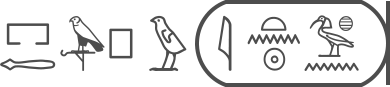 |
|
| pr-ʿ3 pw 3ḫ-n-itn |
Ahkenaten is the pharaoh.
|
| itn pw it.f |
His father is the Aten
|
The translation, “B is A,” was used in the previous example; however, they could have easily been translated as “A is B.” Preference is the main factor involved in this decision. What does the sentence emphasize? Is Akhenaten the emphasis? Then translate “B is A.” Is pharaoh the emphasis? Then translate as “A is B.”It reinforces how Egyptian hieroglyphs can be both flexible and rigid.
Just like A pw nominal sentences, the pw stands as close to the front of the sentence as possible, but always before A. If an indirect genitive stands in position A, then pw is placed before the genitival adjective . If, on the other hand, a direct genitive stands in position A, the pw must follow the direct genitive. Refer to the examples below.
 |
|
| ḥmt nb-m3ʿt-rʿ pw tiy |
“the wife of Nebmaatre is Tiye”
|
 |
|
| mwt pw nt 3ḫ-n-itn tiy |
“the mother of Akhenaten is Tiye”
|
In the first example, pw stands after the noun phrase of A, ḥmt nb-m3ʿt-rʿ. This is because A is a direct genitive, and cannot be separated. However, in the second example, pw intervenes between the first noun of the noun phrase that uses the indirect genitive construction, mwt nt 3ḫ-n-itn.
Noun Clauses
| rḫ.f sḫr is pw nfr |
“He knows that the plan is good.”
|
| ḥr ntt rʿ pw |
“…because he is Re.”
|
There are three components to the first example: a verb (rḫ.f ), an A pw B nominal sentence (sḫr pw nfr), and the marker (is). The particle is stands before the pw in the nominal sentence, allowing the clause to function nominally as the object of the verb.
We find the feminine relative adjective, along with the preposition ḥr, in the second example. This marker, when used in noun clauses, will stand at the front of the noun clause. ntt can be used alone (trans. as “that”), or in conjunction with prepositions. The most common combinations are listed below.
| n ntt | ḥr ntt | ḏr ntt |
| gm.n.i ḥf3w pw |
“I found it was a snake.”
|
Memorization
Vocabulary
| 𓄿𓎛𓏏𓈇 | 3ḥt | Field |
| 𓍯𓄿𓅱𓈗 | w3w | Wave |
| 𓇬𓀁𓅱𓏒𓏥 | wnmw | Food |
| 𓉔𓃀𓍁𓈖𓏭𓆱 | hbny | Ebony |
| 𓋾𓈎𓀀 | ḥq3 | Ruler |
| 𓊃𓂝𓎛𓀾 | sʿḥ | Mummy |
| 𓋴𓃀𓇼𓄿𓇋𓇋𓏏𓏛 | sb3yt | Teachings |
| 𓊃𓊪𓊖 | sp | Time, deed, matter, misdeed |
| 𓐮𓏏𓅂𓌙𓀀𓏥 | styw | Nubians |
| 𓈙𓈇𓏤 | š | Pool, lake |
| 𓆷𓄿𓍯𓃀𓏏𓏭𓀾 | šwbty | Ushabti |
| 𓈎𓈖𓃀𓏏𓊋𓀀𓏥 | qnbt | Court |
Biliterals
| im | in | is |
𓄏 | 𓌤 | 𓍁 |
| ʿb | ʿḥ | hb or triliteral šnʿ |
𓄑 |
𓍱 |
|
| ḥw or bḥ | šn | sš or triliteral sšr |
Triliterals
𓐎 |
𓈄 |
|
| wḥ3 | wḏʿ or psḏ | wḏb |
𓎺 | 𓎸 | 𓏴 |
| ḥnw | ẖnm | sw3 |
𓊶 | 𓌁 | 𓌥 |
| k3p | ḏʿm | ḏb3 |
Exercises
Exercise 1.
Transliterate and translate the following phrases.
𓄿𓎛𓏏𓈇𓏏𓆑𓈖𓏏𓇏𓏏𓏭𓀀
3ḥt tf nt sḫty
“That is a field of a peasant.”
𓈎𓈖𓇋𓏲𓂘𓆱𓉔𓃀𓍁𓈖𓏭𓆱𓊪𓏲
qniw hbny pw
“It is a palanquin of ebony.”
𓐍𓏏𓆑𓀏𓊪𓅱𓈖𓋾𓈎𓀀𓐮𓏏𓅂𓌙𓀀𓏥
ḫfty pw n ḥq3 styw
“He is an enemy of the ruler of the Nubians.”
𓊃𓀀𓏤𓊪𓏲𓊃𓂝𓎛𓀾
s pw sʿḥ
“The man is a mummy.”
5.
𓇥𓂋𓈖𓏏𓏏𓅪𓂋𓋴𓉻𓂝𓄿𓏜𓋴
ḏr ntt wr s(y) ʿ3 s(y)
“Since it is great and it is big.”
6.
𓇾𓈇𓏤𓊪𓏲𓄤𓆑𓂋𓇋𓄿𓄿𓆰𓈉𓂋𓈖 𓆑
t3 pw nfr i33 rn.f
“it was a good land, Iaa was its name.